
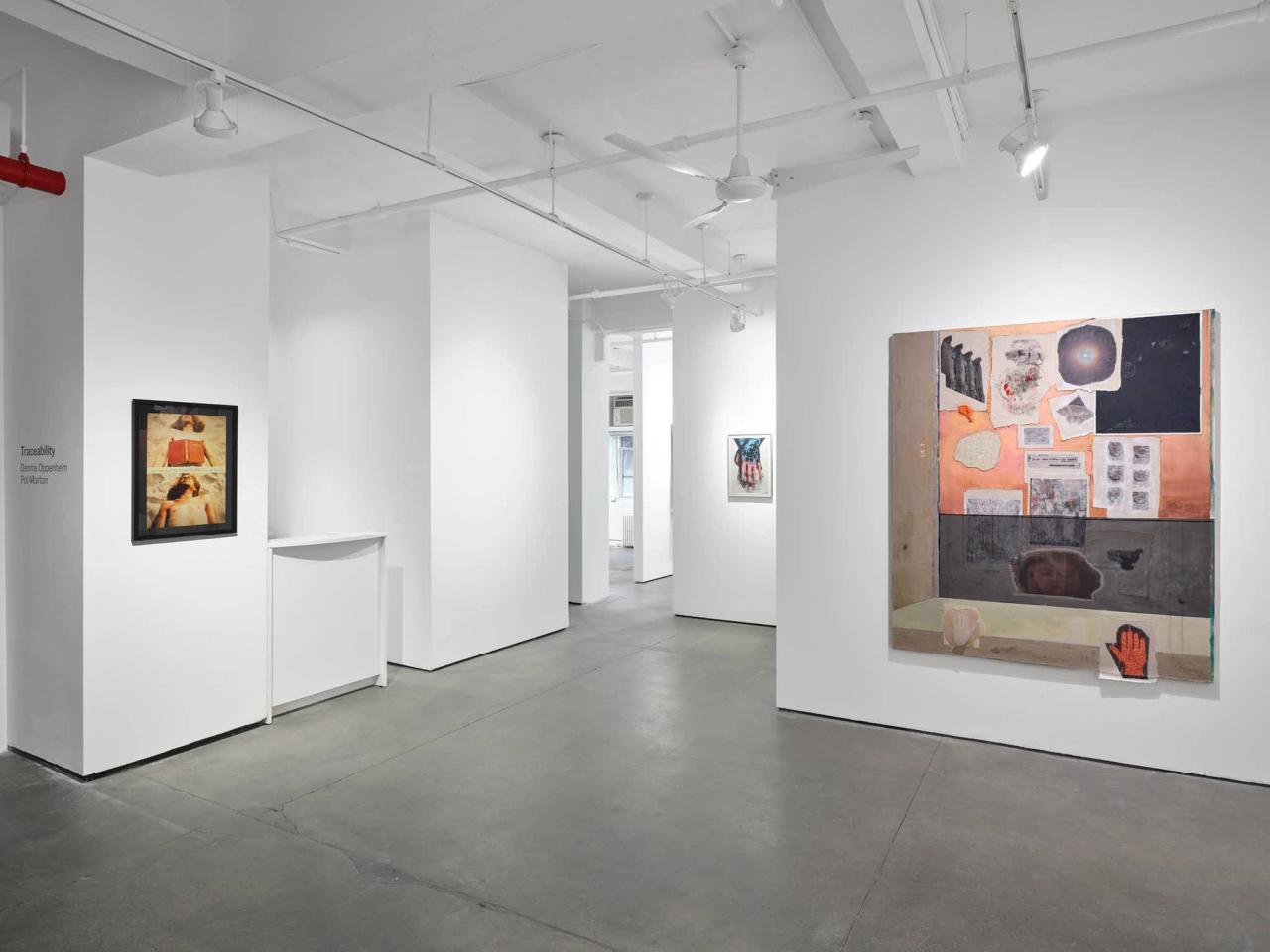
Stux Gallery is pleased to announce its reopening with Traceability, a presentation of new paintings by Pol Morton alongside works by Dennis Oppenheim from the 1990s. The exhibition will premiere a never-before-seen Oppenheim video entitled Mannequin Hands (1994). This pairing is the first in a year of two-artist exhibitions, each placing a legacy Stux artist in conversation with a new voice.
Traceability sets surrogates and records of the body against lived experience through dialogue between artworks made more than three decades apart. A surrogate wholly stands in for a body; a record describes a physical or sociopolitical trait of a body, thus allowing it to be sorted into any number of standardized categories. Both surrogates and records of bodies are treated as the person in these artworks – the surrogates replace the body and the records reduce it, each embodying a mere fragment of personhood.
Both Oppenheim and Morton accept that lived experience is shaped by external forces, but they disagree on the role of the individual. Writing in Artforum in 1978, Jonathan Crary observed that "Oppenheim challenges the notion of a sovereign or autonomous consciousness behind the work."1 Differently, Morton demands consideration of the full person that records redact. At a moment when much of the political conversation in the United States turns to simplistic binaries such as rich vs. poor, old vs. young, trans vs. cis, this exhibition probes what labels signify in the first place.
Oppenheim's Mannequin Hands (1994), a rumination on the surrogate, shows the artist's paint-streaked hands as they cleanse, besmirch, caress, and tangle with a heap of synthetic hands until it is unclear which are acting on which. The mannequin hands, sensitized by the splashing water, grope the artist’s as they leap from the inky basin, as if the copies have revolted against the original.
Proposal for a New American Flag (1992), a monoprint also on view, adds in the record. A flag is a nation's official emblem, a declaration of who belongs. Oppenheim reshapes the stars and stripes, abandoning geometric iconography in favor of human anatomy. Hands, instead, offer a view of the nation’s identity as a breathing collective of human bodies, giving way to the lived experiences the symbol was meant to invoke. Sealed under a glossy, water-resistant vellum, the print takes on the polish of national self-presentation, while beneath it, stripes bleed down the fingers in streaks of red ink. While traditional conceptual artists reject physicality, Oppenheim insists on materiality for the entire human condition.
Morton encounters the record as their subject from inside a body that resists medical and governmental categories. Their preferred gender marker is “X”, a designation the United States bans on passports. Their body, chronically ill in ways visible and invisible, wades in and out of diagnoses. Some of its conditions are documented, while others elude imaging and blood tests. Doctors routinely question what they claim. Studying their own life as an anthropologist, and with a humorous touch, their artwork is a record that articulates the ineffable and verifies experiences others can’t perceive first-hand. In [Untitled], real medical clothing they wore for invasive procedures is crumpled and flattened into plaster molds. The single-use fabric is itchy and unwieldy, and conspicuous bulges balloon to protest being reduced and squished into ill-fitting categories.
[Untitled] and [Untitled] are also diaristic plays on the record. In [Untitled], PET scans of their heart repeat across the canvas. Resembling hazy gelatin prints, the images follow a radiopharmaceutical substance as it wanders through their atria and ventricles, while larger outlines of the scans, the same height as the artist, echo them in the background. In [Untitled], Morton uses their body as the paintbrush, referencing Yves Klein’s body prints at the scale of an MRI machine. Here, traces of their body sunbathe in the rainbow light of the electromagnetic spectrum and the queer flag. This image brings to mind Oppenheim’s Reading Position for Second Degree Burn (1970), for which he lay in the sun with a book on his chest until his skin blistered around it; for both artists, the body becomes a surface that negotiates its own exposure.
Dennis Oppenheim (1938–2011) spent his career testing the boundaries of the self. Oppenheim received his MFA from Stanford and lived and worked in New York City. He has been the subject of numerous solo institutional exhibitions, including at the Whitney Museum of American Art, New York; Los Angeles County Museum of Art; San Francisco Museum of Modern Art; Art Institute of Chicago; Stedelijk Museum, Amsterdam; and Museo Nacional Centro de Arte Reina Sofía, Madrid. His works are part of major permanent collections around the world, including the Metropolitan Museum of Art, New York; The Museum of Modern Art, New York; Centre Pompidou, Paris; Tate Modern, London; Whitney Museum of American Art, New York; Irish Museum of Modern Art, Dublin; Musée d'Art Moderne de la Ville de Paris, Paris; and Stedelijk Museum, Amsterdam.
Pol Morton (b. 1987) received an MFA from Hunter College in 2022 and lives and works in New York. Their work has been exhibited at White Columns, Mana Contemporary, the Beijing American Center, and Luxun Academy of Fine Arts, among other venues. Morton is a recipient of the 2016 Vermont Studio Center Artist's Grant, the 2022 Leeman-Boksenbaum Hunter MFA Thesis Prize, the 2005–2009 Academic Excellence Scholarship and Trustee Award, and the 2007–2008 Painting Department Award from Maryland Institute College of Art.
Founded by Stefan and Linda Stux in Boston in 1980, Stux Gallery was part of New York's gallery life in SoHo and Chelsea for decades. After a ten-year hiatus, it reopens under the leadership of Alva Stux, who returns after a decade in senior roles at Lehmann Maupin, David Nolan, Koenig & Clinton, and Management, in the same building where Stux inaugurated its first Chelsea space in 1996.
For press inquiries, please contact info@stuxgallery.com.